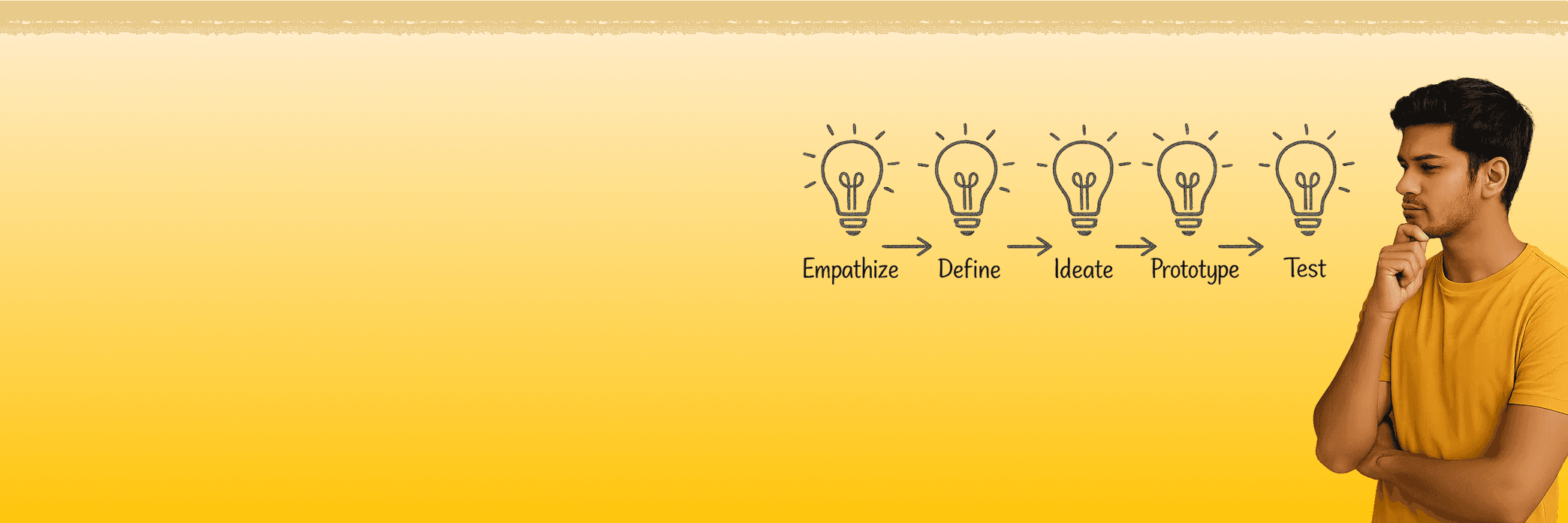
Design Thinking
From Brainstorm to Breakthrough
Design Thinking Mastery is an in-depth course aimed at empowering individuals with the tools, techniques, and mindset necessary to drive innovative solutions. This comprehensive program covers the fundamental aspects of design thinking, emphasizing its practical application in real-world scenarios. Students will learn to harness their creativity, enhance their problem-solving skills, and develop a human-centered approach to innovation. The course offers practical techniques and strategies to approach challenges with fresh perspectives, making it valuable for both personal and professional growth.
Class Age:
- 12 years and above
- This competency-based course is ideal for anyone interested in applying design thinking for innovation and creative problem-solving, suitable for students, professionals, entrepreneurs, trainers and educators.
Course Duration:
- 3 modules
- 16 sessions/module
- 2 sessions/week
- 1.5 hours/session
Topics

Module 1
- Understanding the Brain
- Modes of Thinking
- Critical Thinking vs. Creative Thinking
- Divergent and Convergent Thinking
- The Taxonomy of Creative Design
- Methods of Creative Problem-Solving
- Measure of Creativity
Module 2
- Design Thinking Fundamentals
- Origin
- Concepts
- Benefits
- The Design Thinking Model
- Research and Analysis
- Brain Storming
Module 3
- Phases of Design Thinking
- Empathizing
- Defining
- Ideation
- Prototype Design
- Iteration and Scaling
- Final Project
Course Objectives
- Understand the neuroscience behind creative thinking and its role in innovation.
- Distinguish between critical and creative thinking, and learn to integrate both for effective problem-solving.
- Strengthen divergent and convergent thinking using the taxonomy of creative design.
- Apply creative problem-solving techniques to real-world innovation challenges.
- Gain a deep understanding of the origins, concepts, and benefits of design thinking.
- Use research methods to collect and analyze qualitative and quantitative data, including developing effective interview questions.
- Analyze research insights to guide the design process.
- Master the five phases of design thinking: Empathize, Define, Ideate, Prototype, and Iterate.
- Build, test, and refine low-fidelity prototypes with strategies for scaling successful ideas.
Course Outcomes
- Develop a deep understanding of design thinking principles and practices.
- Enhance their critical and creative thinking skills.
- Learn to conduct effective research and analyze user data.
- Apply design thinking to solve complex problems and create innovative solutions.
- Gain practical experience in prototyping and iterative design.
- Improve their ability to work collaboratively and communicate ideas effectively.