Math O Logic
Think Smart. Solve Fast.
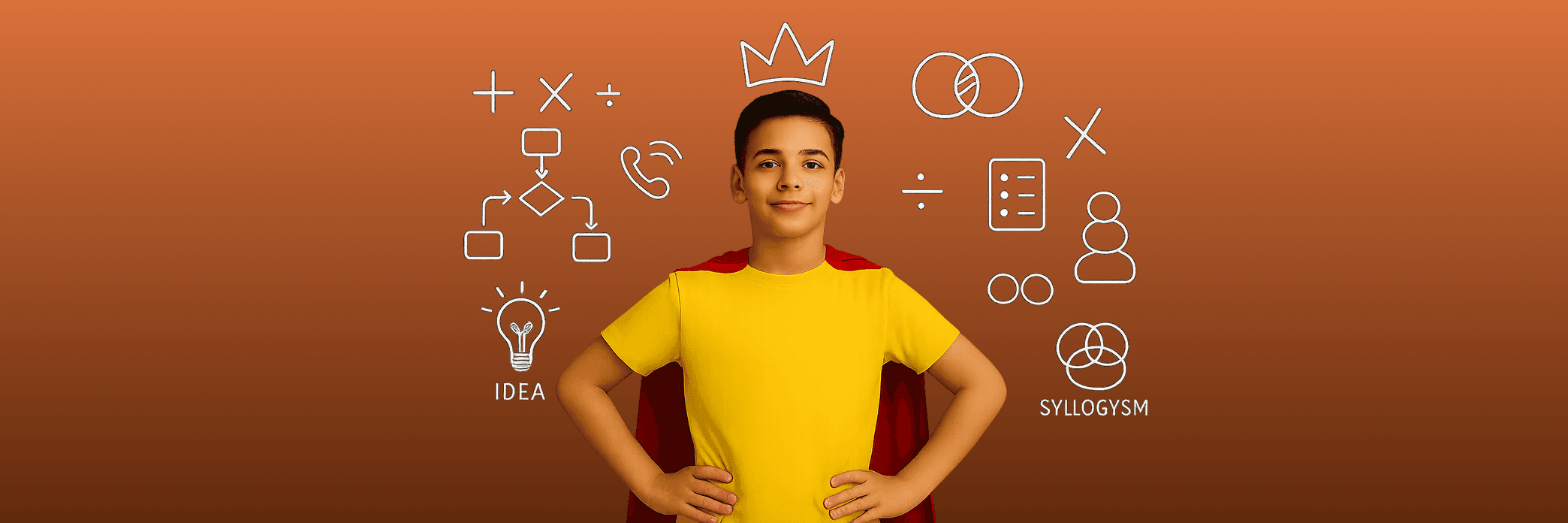
Math O Logic is an engaging course that strengthens critical thinking, computation, and problem-solving skills in young learners. It blends traditional math with logical, verbal, and non-verbal approaches—using patterns, images, sequences, flowcharts, Venn diagram, syllogism, analogies, logic map and more. Through interactive games, puzzles, and real-life applications, students gain a deeper understanding of concepts and develop essential 21st-century skills like analytical thinking and decision-making, all in a fun and inspiring way.
Class Age:
- 4–12 years
- 6–7 years
- 8–9 years
- 10–12 years
Course Duration:
- 8 Levels
- 16 sessions in each
- 2 sessions/week
- 1.5 hours/session
Topics

Mathematical Reasoning
- Smart Counting
- Tally Counting
- Grid Math
- Data Table
- Chart & Graph
- Conditions and Grouping
- Math O Logic in Everyday Situation
- Arithmetic Operations &
- Financial Head Start
- Mini Project
- Fun Games & Group Activities
Logical Reasoning
- Logic Grid
- Word Puzzle
- Flow Chart
- Syllogism
- Logic Map
- Truth Table
- Cause & Effect
- Venn Diagram
- Blood Relations
- Coding Decoding
- Seating Arrangement
- Fun Games & Group Activities
Non-Verbal Reasoning
- Grid Puzzle
- Dot Puzzle
- Ranking
- Shape Analogy
- Picture Analogy
- Image Analysis
- Series & Sequence
- Number Pattern and Sequences
- Direction Sense Test
- Interactive Simulations
- Fun Games & Group Activities
Course Objectives
- Boost number sense, computation, and critical thinking.
- Sharpen understanding of math concepts and reasoning.
- Build non-verbal reasoning through puzzles and patterns.
- Strengthen logic using grids, flowcharts, and maps.
- Apply math in real life to grow financial literacy.
Course Outcomes
- Build a strong foundation in mathematical, logical, and non-verbal problem-solving.
- Enhance critical thinking, improve reasoning, and gain confidence in applying these skills both academically and in daily life.
- Complete the course with a portfolio of puzzles, activities, a mini project, and simulations that reflect their progress and achievements.